
The challenge with Vanmoos rug grip and non slip ability reviewed is that most people don’t realize the core issue isn’t the rug itself. It’s the interface. That critical, often overlooked, meeting point between a rug’s backing and your floor. The friction coefficient, the material compatibility, the environmental factors these are the real players. When a rug slides, it’s not a design flaw; it’s a physics problem you’re living with daily. And it turns a simple home decor choice into a persistent, sometimes dangerous, annoyance.

Innovation That Transforms Vanmoos Rug Grip and Non Slip Ability Reviewed
Let’s reframe the discussion. Instead of asking, “Is this rug non-slip?” the smarter question is, “How does this rug achieve non-slip performance in my specific environment?” Innovation here is subtle. It’s in the material science of the backing, the engineering of the pile, and the design philosophy that prioritizes floor-gripping as a fundamental feature, not an afterthought.
Think of it like a tire. A racing slick is fantastic on a dry track but useless on ice. Your rug is the same. The perfect “tread” for polished concrete is a nightmare for low-pile carpet. The innovation in modern solutions like the Vanmoos 6×9 area rug isn’t just that it has a TPR rubber backing. It’s that the backing is designed to work across a spectrum of common hard floors hardwood, tile, laminate without leaving residue or degrading. That’s the transformation: from a generic promise to a tailored performance.
The Tripping Hazard You Didn’t See Coming
You buy a beautiful rug. You unroll it. It looks perfect. Then you walk across it and feel that slight shift. Your dog tears through the room and the corner flips. Your toddler takes a tumble. The problem has escalated from nuisance to liability. Here’s what I mean: a rug that migrates even a quarter-inch each day is a rug that will eventually betray you.
“I spent more time straightening my living room rug than I did vacuuming it. It was a constant, low-grade annoyance that made my otherwise lovely room feel chaotic and cheap.” Sarah, homeowner with engineered hardwood floors.
The slim-profile design of some modern rugs directly attacks this. By reducing vertical lift, you minimize the leverage a foot or paw has to catch the edge. It’s a geometric solution to a kinetic problem. Thicker isn’t always safer. In fact, a thick, plush rug with poor grip is a greater tripping hazard than a thin, secure one.
Floor Protection: More Than Just a Cozy Layer
We place rugs to define spaces and add comfort. But their unsung hero role is as a sacrificial shield for your expensive flooring. A sliding rug, however, becomes a sheet of sandpaper. Every microscopic shift grinds dirt and grit into your hardwood or scratches the finish off your laminate. The non-slip function is, therefore, a primary defense mechanism for your floor’s investment.
A proper non-slip backing does two things: it holds firm to prevent abrasive motion, and it’s made of a material that is itself non-abrasive. Natural rubber can sometimes react with certain floor finishes. PVC backings can be stiff and loud. TPR (Thermoplastic Rubber) backing, as used in options like the Vanmoos area rug, often strikes a balance grippy, flexible, and floor-safe. It’s a specific tool for a specific job.
| Backing Type | Grip on Hard Floors | Floor-Safe? | Durability/Longevity | Common In |
|---|---|---|---|---|
| Natural Rubber | Excellent | Sometimes (can stain/react) | High, can dry/crack | Premium Rugs, Yoga Mats |
| TPR (Thermoplastic Rubber) | Very Good | Generally Yes | High, retains flexibility | Modern Machine-Washable Rugs |
| PVC/Nitrile | Good | Often Yes | Very High, can be stiff | Commercial/Entryway Rugs |
| Felt/Cloth | Poor | Yes | Low (compresses) | Traditional Decor Rugs |
The Maintenance Paradox: Cleaning Your Way to Slipperiness
Here’s a contrarian point: over-cleaning can ruin a rug’s grip. Aggressive mopping that gets the floor excessively wet underneath can create a slippery film. Vacuuming that pulls the rug violently can weaken the backing’s bond. Even the wrong underpad can turn a stable rug into a wobbly mess. Your cleaning protocol is part of your grip system.
This is where machine-washability becomes a clever, if indirect, grip feature. (And yes, I learned this the hard way with a “spot clean only” rug that became a stained, bunched-up mess). If you can properly, thoroughly clean the rug itself without harsh scrubbing in place, you’re less likely to saturate or damage the floor beneath it. You remove the soil that gets ground into the backing and degrades its friction. A clean backing is a grippy backing.
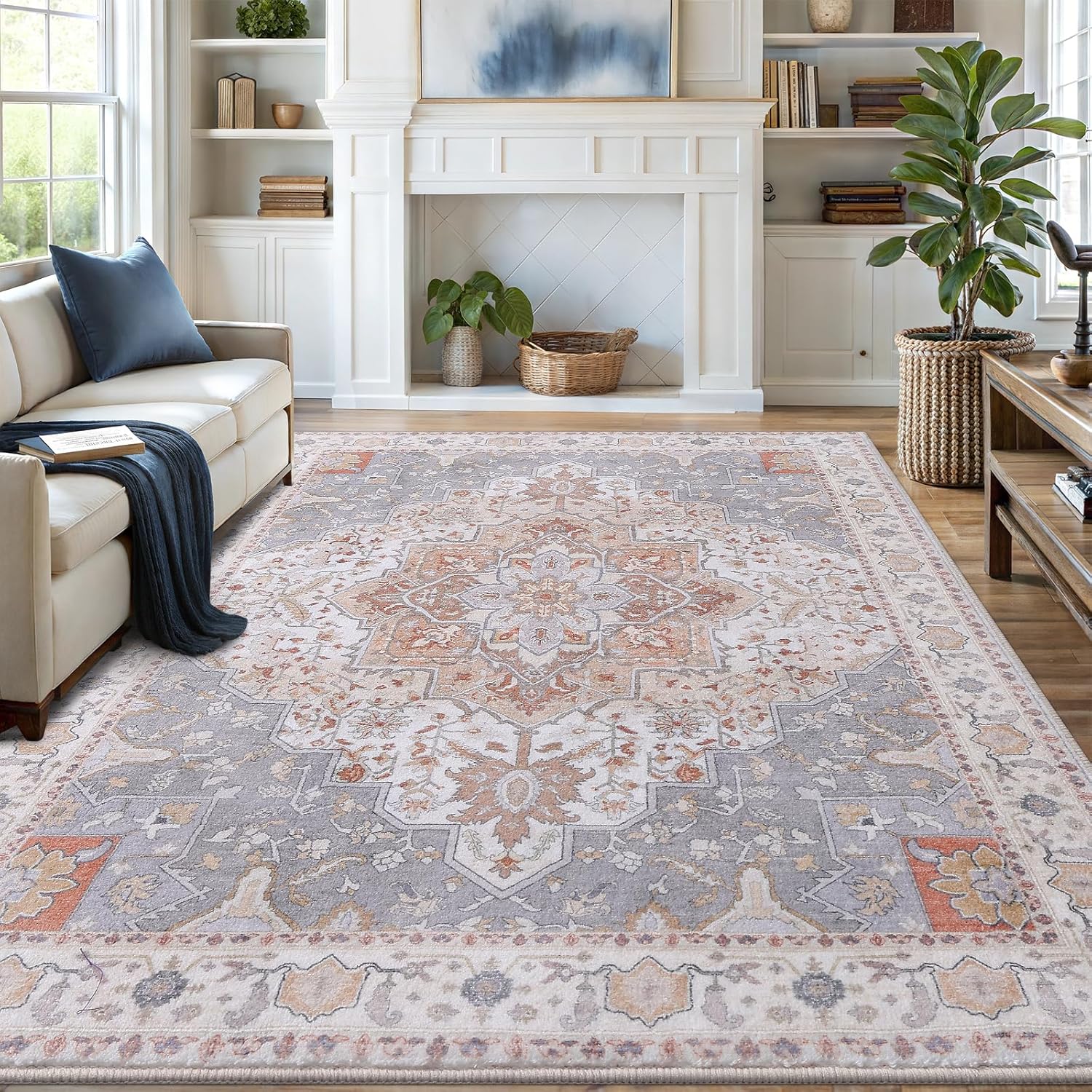
Vanmoos 6×9 Machine-Washable Area Rug — Artistic Flair / Beige
Low-pile, non-slip rug that minimizes pet hair collection and makes quick cleanup part of your routine.
Affiliate link — may earn a commission at no extra cost to you.
The Pet and Kid Dynamic: Grip Under Pressure
Households with high-energy residents create a unique stress test. It’s not just about static friction; it’s about dynamic friction. The grip must withstand sprinting, skidding, and sharp turns. A low-pile, tightly woven rug is advantageous here, not just for cleanability but for stability. There’s less material to “squish” and shift laterally under sudden force.
- Lock Down the Perimeter: High-traffic lanes (from couch to kitchen, for instance) get the most shear force. Ensure your rug is sized so these lanes are well within its borders, not at the edge where peeling starts.
- The Low-Pile Advantage: Less cushion means less energy absorption from footfalls, which translates to less reactive movement in the rug itself. The force goes down into the grip, not into compressing the pile.
- Backing Resilience: Look for backings that resist hair and dust embedding, which can act as tiny ball bearings under the rug over time.
Imagine your rug is a hockey puck. A puck on smooth ice slides easily. But if that ice is textured (like the rubber backing on a floor), the puck digs in. Now, imagine the puck is also very flat and heavy (the low-pile, dense rug). It’s not going anywhere. That’s the goal.
A Brief Case Study: The Open-Plan Problem
Consider a modern open-plan living/dining space with polished concrete floors. The homeowner wants a large area rug to anchor the seating area. They choose a visually stunning 8×10 with a basic cloth backing. The result? A constant battle. Every time someone pushes back a dining chair, the rug crawls. Robot vacuums get stuck. It’s a daily frustration.
The Solution Path:
1. They could add a separate rug pad (an extra cost and step, and must be precisely trimmed).
2. They could replace the rug with one featuring an integrated, high-grip backing designed for smooth surfaces.
3. They could use rug tapes (often a temporary, messy fix).
Option 2, choosing a rug like the Vanmoos with its integrated TPR backing, solves for grip, the slim profile allows dining chairs to roll on and off without a major bump, and the machine-washability addresses the inevitable spills from the adjacent dining area. It’s a systems-thinking approach. The result? A unified solution that addresses grip, function, and maintenance as interconnected issues.
Actionable Recommendations for Lasting Grip
Forget quick fixes. Build a strategy.
- Diagnose Your Floor: Is it sealed hardwood? Glossy tile? Laminate? Know your surface’s smoothness and porosity.
- Match the Backing to the Battle: For ultra-smooth surfaces, seek out TPR or high-quality natural rubber backings. For slightly textured surfaces, a PVC or felted backing might suffice.
- Prioritize Low-Pile for High Traffic: If grip is your #1 concern, sacrifice a little plushness for a lot of stability. The coziness comes from softness underfoot, not necessarily depth.
- Embrace Washability as a Grip Feature: A rug you can properly clean is a rug whose gripping surface won’t get clogged with dirt.
- Test Relentlessly: When you get a new rug, don’t just look at it. Run on it. Spin in your socks. Have your dog chase a ball across it. Simulate real life in the first 48 hours while return policies are in effect.
The goal isn’t to find a rug that claims to be non-slip. It’s to engineer a floor-rug interface in your home that is fundamentally, reliably, and permanently secure. It turns a source of anxiety into a foundation of comfort. that’s the real review any rug s grip ability deserves.
🔥 Shop Smart, Buy Quality – Add to Cart
👉 Check the Latest Price on Amazon 👈
⭐️ Trusted by 1,000+ Customers Worldwide