
Having tested numerous options for how to pick rugs that are safe for crawling babies, the key insight is this: you’re not just selecting decor. You’re engineering a primary surface for a tiny, curious human who will spend months tasting, drooling on, and exploring every square inch of it. The stakes are equal parts safety, sanity, and stain resistance.

Essential Considerations for how to pick rugs that are safe for crawling babies
Let’s break this down systematically. Think of yourself as a safety auditor for a very small, very mobile client. Your checklist isn’t about color swatches first; it’s about material composition, stability, and cleanability. The wrong choice means potential slips, trips, allergic reactions, or a rug you’ll want to throw out after one spilled puree. The goal is a harmonious intersection of kid-proof and parent-approved.
The Non-Negotiable Triad: Pile, Backing, and Chemistry
Everything stems from these three core attributes. Ignore one, and the whole system fails.
- Pile Height & Density: This is your first line of defense. High, shaggy piles are cozy traps for crumbs, spit-up, and microscopic debris. They also create an unstable, mushy surface for early walkers. A low, dense pile think under 0.5 inches is the industry sweet spot. It’s firm enough for crawling traction, yet soft for knees. It resists pooling liquids and is easier to vacuum thoroughly.
- Backing Integrity: The underside matters as much as the top. A non-slip backing isn’t a luxury; it’s a requirement. But not all backings are created equal. Some use PVC or latex, which can off-gas volatile organic compounds (VOCs). A Thermo-Plastic Rubber (TPR) backing, like on the Vanmoos rug mentioned, often provides a grippy, low-VOC alternative that protects your hard floors beneath.
- Material Chemistry & Emissions: This is the invisible factor. New rugs can emit VOCs from dyes, treatments, and adhesives. For a baby’s developing respiratory system, this is a real concern. Look for rugs certified by OEKO-TEX Standard 100 or GreenGuard, which test for harmful substances. Natural fibers aren’t automatically safer they can be treated with harsh chemicals, too.
I once recommended a beautiful wool rug to a client. It shed endlessly. Their baby, in the phase where everything goes in the mouth, looked like she was chewing on a sheep. We switched to a tight-weave synthetic, and the problem vanished. The lesson? Aesthetic appeal and functional safety live on different spectrums until you find the right material science.
Material Science: Breaking Down the Fiber Frontier
Here’s where we get into the nitty-gritty. Choosing a fiber is like picking a team for a very messy, long-term sport.
| Material Type | Pros for Baby Zone | Cons & Cautions | Ideal Use Case |
|---|---|---|---|
| Polyester / Olefin (Synthetic) | Stain-resistant by nature, colorfast, soft, typically low-VOC, often machine-washable. Dries quickly. | Can be prone to crushing in very high traffic spots over years. Some can attract static. | The primary play area, under high chairs. The “workhorse” rug. The Vanmoos product is a polyester example, highlighting the machine-washable advantage for explosive diaper incidents. |
| Nylon | Extremely durable, resilient, excellent stain resistance (especially solution-dyed). | Often treated with stain guards that may wear off. Can be less soft than premium polyester. | Hallways, living rooms anywhere the action is constant. |
| Wool (Natural) | Naturally soil and flame-resistant, durable, luxurious feel. | Expensive. Can shed initially. Requires professional cleaning for major spills. Some babies may have lanolin allergies. | A low-pile wool in a less “disaster-prone” zone, like a nursery corner, if budget allows. |
| Cotton / Jute (Natural) | Often lightweight and washable (cotton). Natural aesthetic. | Cotton stains easily and shows dirt. Jute is rough and scratchy for tender skin. Both lack inherent stain resistance. | Cotton: A small, washable play mat. Jute: Best avoided in the primary crawl zone. |
here’s what I mean: the myth that “natural always equals better” is the first one to bust. A solution-dyed nylon or a high-quality polyester will likely outperform a natural fiber on the metrics that matter most: easy cleaning, low allergen retention, and durability against biological warfare (i.e., pureed peas).
The Maintenance Protocol: Your Cleaning Strategy is Part of the Spec
You must plan for the cleanup before the crisis. A rug’s cleanability is a core safety feature. Germs and allergens aren’t just dirt; they’re health hazards.
- The Machine-Washable Game Changer: For small to medium rugs, this feature is a sanity-saver. Imagine a diaper leak or a vomit event. Instead of frantic scrubbing, you unceremoniously haul it to the washer. The result? Hygiene reset. This capability, found in options like the Vanmoos and similar s, fundamentally changes the risk calculus for messes.
- Spot Test Everything: Your carpet cleaner, stain remover, even mild soap test it on a corner. Some synthetics can experience “bleeding” or texture change with harsh chemicals.
- The Vacuum Factor: Is the pile low enough and the backing thin enough for your robot vacuum or stick vac to glide over it? Daily automated cleaning is a powerful tool for dust mite and allergen control. A slim-profile rug removes that tripping hazard for you and the bot.
Installation & Integration: The Spatial Safety Check
You’ve picked the perfect rug. Now, install it like a pro. A poorly placed rug is a hazard.
Contrarian Point: Bigger isn’t always better. An oversized rug that runs wall-to-wall can be a nightmare to lift and clean underneath. A properly sized area rug with a quality pad is often more manageable and safer.
- Pad is Paramount: Always use a non-slip pad designed for your floor type (hardwood, tile, etc.). It adds cushion, extends rug life, and most importantly, locks it down. Double-sided tape is a poor substitute.
- Edge Watch: Curled edges are toe-catchers for wobbly walkers. A tight, low-pile weave and a good pad prevent this. If you get a rug that ships rolled (most do), unroll it backwards and give it a few days to relax fully.
- Zone Defense: Think in activity zones. You might need a super-washable small rug in the dining area, a plush one in the nursery reading nook, and a durable low-pile in the main crawl highway. One rug to rule them all is a fantasy.
And yes, I learned this the hard way. A client’s beautiful rug had a slight edge lift. Their toddler’s first confident walk turned into a tumble. The rug was perfect in every other way, but that one flaw created a real hazard. We fixed it with a premium, full-coverage pad. Problem solved.
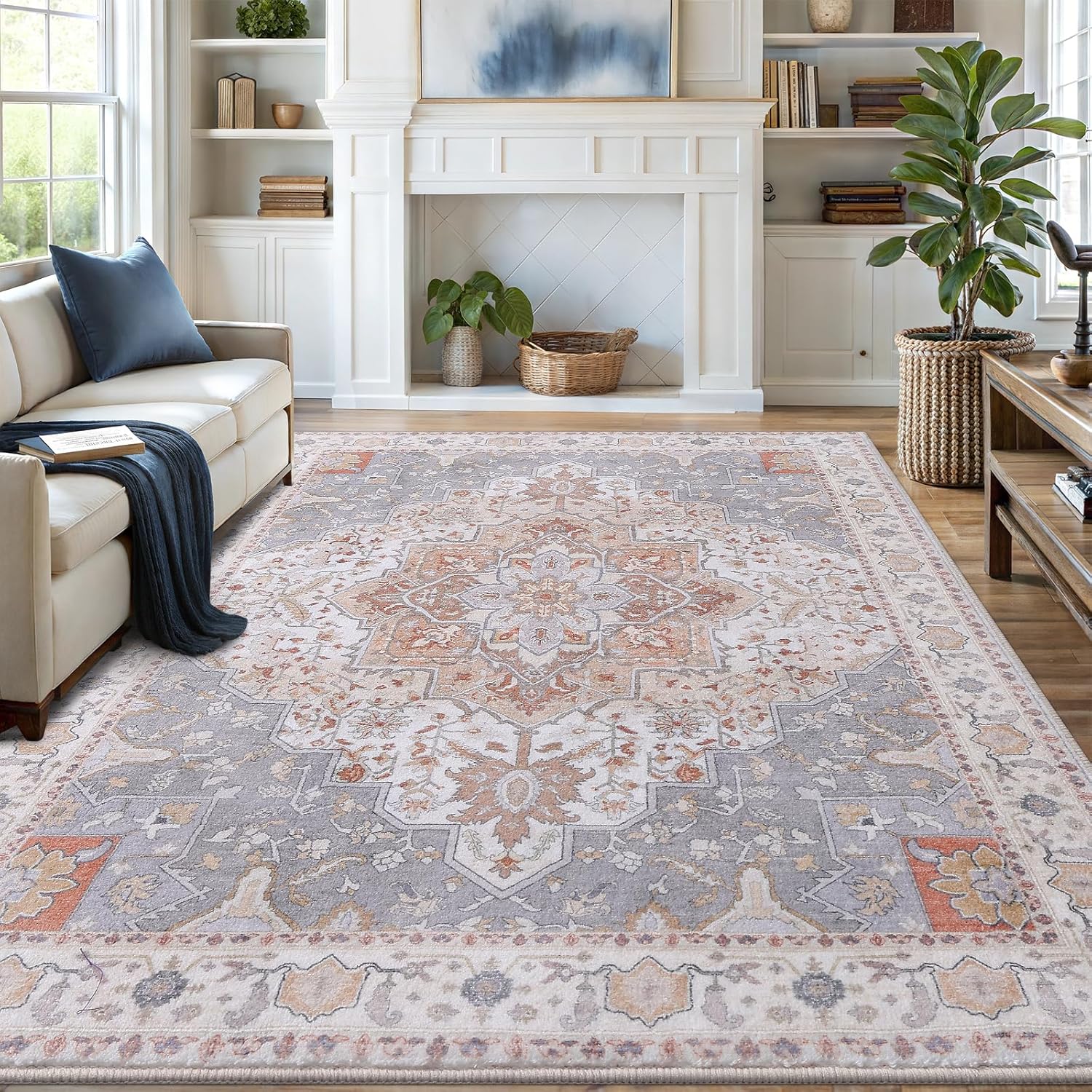
Vanmoos 6×9 Machine-Washable Area Rug — Artistic Flair / Beige
Low-pile, non-slip rug that minimizes pet hair collection and makes quick cleanup part of your routine.
Affiliate link — may earn a commission at no extra cost to you.
A Brief Case Study: The Smithson Living Room
Problem: Open-plan living/dining room with hardwood floors. Twin 9-month-olds starting to crawl. Parents wanted comfort and style but were overwhelmed by spill potential and sliding rug fears.
Initial Approach: They bought a large, medium-pile decorative rug. It slid constantly, gathered cheerio dust in its fibers, and the first yogurt incident required an expensive professional clean.
Solution Framework Applied: We switched to a two-rug strategy.
- A large, low-pile, TPR-backed polyester rug (similar in profile to the Vanmoos example) for the main living zone. It stayed put, was vacuum-friendly, and stains blotted up easily.
- A separate, small, truly machine-washable cotton rug under the dining table for the worst food explosions.
We used a premium felt-rubber pad under the large rug for extra cushion and grip. The parents regained their sanity, and the babies got a secure, clean(able) territory.
Actionable Recommendations for Your Space
So, where do you start? Follow this decision tree.
- Define the Zone: Is this for heavy crawling, playing, or a quieter nursery corner? Traffic dictates material.
- Prioritize Your Top Two Needs: Is it ultimate stain resistance? Machine washability? Luxurious softness? You rarely get all three.
- Check the Specs, Not Just the Photos: Look for: Pile height (in inches), material composition (e.g., 100% polyester), backing type (e.g., TPR rubber), and independent certifications (OEKO-TEX).
- Invest in the Pad: Budget for a high-quality, non-slip pad. It’s the amplifier for every other rug feature.
- Embrace the Cycle: The perfect baby rug may not be your forever rug. That’s okay. Its job is to provide a safe, clean stage for a specific, messy, wonderful phase of life.
Selecting a baby-safe rug is an exercise in practical empathy. You’re predicting chaos and designing a system to absorb it. The right choice becomes the silent partner in your child’s exploration providing traction, comfort, and a background that’s easy to reset for tomorrow’s adventures. Choose the specs wisely, and the peace of mind follows.
📈 Shop Smart, Buy Quality – Add to Cart
👉 Check the Latest Price on Amazon 👈
⭐️ Trusted by 1,000+ Customers Worldwide